

The so-called “12%” popular initiative was approved by the voters of the Canton of Vaud in a referendum held on September 27, 2026. The initiative called for a uniform 12% reduction in cantonal income and wealth taxes in the Canton of Vaud.
This tax cut will take effect on January1, 2027. The Vaud government now wishes to abolish the tax cuts granted for 2025 and 2026, as well as the one planned for 2027, to avoid a “cumulative effect.” This legislative amendment requires a vote by the Vaud Parliament. The Grand Council did not have the opportunity to address this issue during its session on October 6, 2026 (see the minutes of the October 6, 2026, session, p. 15).
The approval of this initiative by voters in Vaud now raises a key question: Is a 12% reduction in cantonal taxes sufficient to offset the effects of maintaining the tax cap in its 2021–2022 version?
Several factors suggest that the impact of this tax cut should be viewed in context, particularly for taxpayers with substantial wealth.
But before answering that question, let’s take a step back, since this referendum has been the subject of much discussion.
Voting Procedure Upheld by the Federal Court
In its decision 9C_541/2025 of April 22, 2026, the Federal Supreme Court dismissed the appeal filed by the initiative’s sponsors against the Vaud government’s decision to link the issue of the tax shield to the outcome of the 12% initiative at the polls. Our Supreme Court thus confirmed that the Grand Council was within its rights to make a potential return to the tax cap in its pre-2021 form contingent upon the rejection of the so-called “12%” popular initiative.
The dilemma underlying the vote
The referendum on September 27, 2026, presented voters in Vaud with a complex choice: to accept a general reduction in cantonal taxes while maintaining the tax cap in its current form, or to forgo this tax cut, thereby paving the way for a return to the “pre-2021” tax cap—which is more favorable but affects only a limited number of taxpayers.
The tax impact of maintaining the tax shield in its 2021/2022 form is particularly significant for high-net-worth taxpayers, whose tax contributions may account for a significant portion of Vaud’s tax revenue. Maintaining the tax cap in its 2021–2022 version is likely to significantly and permanently increase the tax burden on certain taxpayers compared to the pre-2021 version of the Vaud tax cap. Such a development could prompt some to move to a canton with a more favorable tax regime or even to leave Switzerland. The departure of these taxpayers would lead to a decrease in tax revenue and would likely weigh on public finances. Ultimately, the authorities may be compelled to consider compensatory measures, including a potential tax increase.
Conversely, rejection of the initiative would have allowed the existing tax system to remain in place, without, however, resolving the issue of the high tax burden borne by all taxpayers in the Canton of Vaud. And while some wealthy taxpayers may have already left the canton ahead of the referendum, the resulting loss of revenue could nevertheless have put pressure on public finances.
In short, voters were faced with a difficult choice: a limited but certain tax cut on the one hand, and a return to a less confiscatory tax system for certain wealthy taxpayers on the other. It goes without saying that the potential consequences surrounding the tax cap are abstract and will, at best, have an indirect effect on taxpayers (by extension). As such, they are less straightforward to pinpoint.
Regardless of the scenario envisaged in light of the referendum result, the risk of tax revenue losses—and consequently, an increase in the tax burden or a forced reduction in the state budget—cannot therefore be ruled out. The trend in tax revenue and the canton’s budgetary decisions will be decisive.
The challenge with the shield
The Vaud tax cap, as applied since January1, 2022, has led to an increase in the tax burden for taxpayers who benefit from it and a decrease in the number of taxpayers who fall within its scope. The eligibility threshold has been raised.
This change stems primarily from the inclusion of dividends from qualifying equity interests on a gross basis—that is, without the equity interest deduction—in the calculation basis. (See the Department of Finance and Agriculture’s Guide dated April 26, 2024.)
No significant reduction in the tax burden
The 12% initiative applies exclusively to cantonal taxes. It does not apply to municipal taxes or direct federal taxes. Its impact on the overall tax burden of taxpayers in Vaud must therefore be assessed in light of these limitations. In any case, this constitutes a first step toward bringing the tax burden in Vaud closer to the national average.
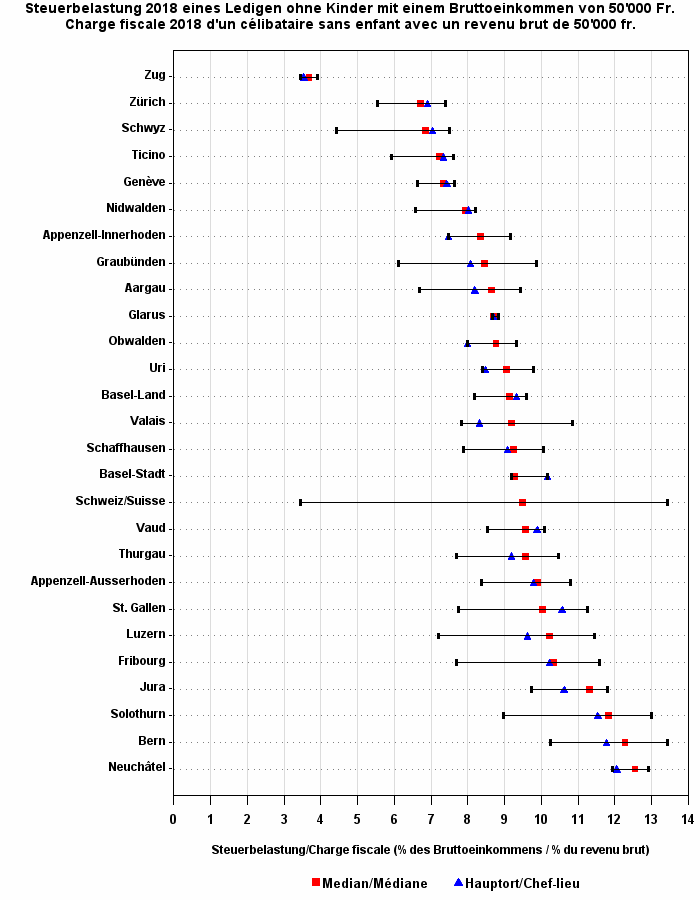
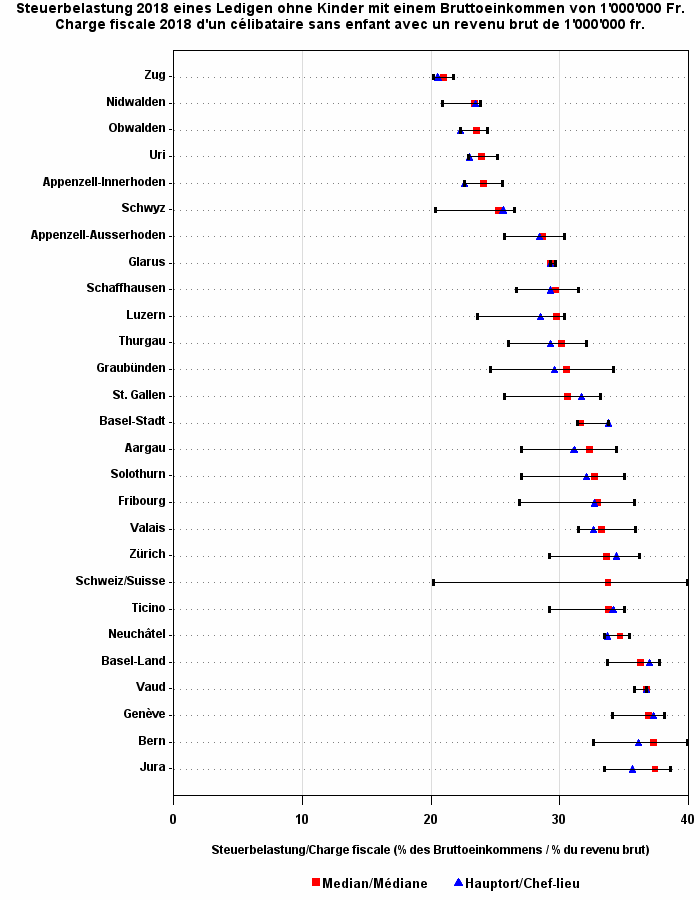
To date, only statistics through 2018 have been published. The charts below, illustrating two scenarios among many others, show the difference in tax burden across the cantons. We have selected two extremes: a single taxpayer with no children and a gross income of CHF 50,000 in one case, and CHF 1,000,000 in the other. The cantons are ranked in ascending order of tax burden. In both cases, the Canton of Vaud ranks in the latter half of the list, or even among the lowest. However, these tables do not yet take into account the recent tax cuts implemented in various cantons, including the Canton of Vaud, Geneva, and Aargau. These cuts are likely to alter the rankings somewhat.
For example, in Lausanne, where the maximum wealth tax rate currently stands at 0.79 percent, a 12 percent reduction in the cantonal tax would bring that rate down to approximately 0.73 percent, all other things being equal. The effective rate would thus remain particularly high by intercantonal standards.
For taxpayers with substantial wealth, this reduction may therefore prove insufficient to offset the effects of maintaining the tax cap in its 2021–2022 version.
Does the tax cap still prevent confiscatory taxation?
Following the approval of the 12% initiative, the tax cap will continue to apply in its 2021–2022 version.
This perspective raises a fundamental question: To what extent can a mechanism designed to limit the tax burden still be called a “tax shield” when its application results, for certain taxpayers, in a substantial increase in taxes compared to the previous system?
Beyond this question of terminology, it is above all the constitutionality of taxation for wealthy taxpayers whose wealth generates little or no income that deserves special attention.
Two constitutional principles, in particular, are at stake:
- The right to property (Art. 26, para. 1, of the Constitution), which in principle should preclude so-called confiscatory taxation.
- The principle of taxation according to the ability to pay (Art. 127, para. 2, of the Constitution), which requires that the tax burden be distributed in accordance with taxpayers’ economic capacity.
This raises the question of whether the Vaud wealth tax, as applied under the 2021–2022 version of the tax shield, complies with these constitutional requirements in all situations it is likely to cover. A thorough analysis of its calculation methods, its practical effects, and the resulting overall tax burden remains necessary to assess this issue. To trigger such a review by the Federal Supreme Court, a taxpayer, such as Arnold de Winkelried, would need to challenge his tax assessment all the way to our High Court, so that the Court may rule on the matter.
However, given the existing case law on the matter, the chances of success appear slim. Indeed, the Federal Supreme Court holds that “ [i]t is only when taxation, including wealth tax, consistently exceeds income—including returns on wealth—that it can be concluded that the wealth has been so depleted that the taxation must be characterized as confiscatory […] only if the returns on the assets are insufficient to cover the tax burden over the long term should taxation be characterized as confiscatory.” (ATF 143 I 73, para. 5.2).
What Does the Future Hold for the Canton of Vaud’s Tax Attractiveness?
The approval of the 12% initiative therefore does not put an end to the debate on taxation in Vaud. On the contrary, it ushers in a new phase of reflection on the balance between government revenue, government services, government efficiency, tax equity, and the canton’s attractiveness.
It is now up to the government and the Vaud legislature to examine the adjustments that could reconcile these various objectives, particularly with regard to the tax treatment of taxpayers with substantial wealth that does not generate sufficient income to cover the wealth tax.
In the context of international and intercantonal tax competition, the Canton of Vaud’s ability to retain its taxpayers and maintain a solid tax base is a major challenge for public finances.
Based on this observation, several measures can be taken to legally reduce the tax burden, including a change of residence or a reorganization of assets. PANCHAUD Tax & Legal SA assists its clients with these processes.
Frequently Asked Questions
The initiative called for a uniform 12% reduction in the cantonal income and wealth tax in the Canton of Vaud. It was approved by voters in Vaud on September 27, 2026.
This tax cut will take effect on January1, 2027.
The 12% initiative applies exclusively to cantonal taxes. It does not apply to municipal taxes or direct federal taxes.
Following the approval of the 12% initiative, the tax cap will continue to apply in its 2021–2022 version.
The Vaud tax shield, as applied since January1, 2022, has led to an increase in the tax burden for taxpayers who benefit from it and a decrease in the number of taxpayers who fall within its scope. The eligibility threshold has been raised. This change stems primarily from the inclusion of dividends from qualifying equity interests on a gross basis—that is, without the equity interest reduction—in the calculation basis.
For example, in Lausanne, where the maximum wealth tax rate currently stands at 0.79 percent, a 12 percent reduction in the cantonal tax would bring that rate down to approximately 0.73 percent, all other things being equal. The effective rate would thus remain particularly high by intercantonal standards.
The Federal Supreme Court holds that “[i]t is only when taxation, including wealth tax, consistently exceeds income—including returns on wealth—that it can be concluded that the wealth has been so depleted that the taxation must be characterized as confiscatory […] only if the returns on the assets are insufficient to cover the tax burden over the long term should taxation be characterized as confiscatory.” (ATF 143 I 73, para. 5.2).
There are several measures that can be taken to legally reduce the tax burden, including a change of residence or a reorganization of assets. PANCHAUD Tax & Legal SA assists its clients with these processes.
Author: Cedric PANCHAUD, Attorney at Law, Doctor of Law, Licensed Notary, Certified Tax Expert, PANCHAUD Tax & Legal SA
October 26, 2026

September 21, 2026

September 1, 2026