

Mandatory occupational pension plans (LPP) are well known to executives and self-employed individuals. The non-mandatory portion of these plans is much less well known, yet it is this portion that offers the greatest potential for tax optimization. For those with an annual income of CHF 100,000 or more, the difference between a plan structured to meet the legal minimum and a well-designed plan can amount to several hundred thousand francs at retirement.
Mandatory vs. Voluntary LPP: The Basics
The LPP, or occupational pension plan, is based on the Occupational Pension Act[1], which took effect on January1, 1985—a little over 40 years ago—and has its origins in a 1972 constitutional amendment establishing a three-pillar pension system in Switzerland, namely the AVS, the LPP, and voluntary pension plans (also known as the third pillar)[2].
“On December 3, 1972, the people and the cantons approved a constitutional article on old-age, survivors’, and disability pensions that enshrines the three-pillar principle. Benefits under the first pillar (state-provided social security = AVS, AI, and supplementary benefits) [sic] are intended to cover basic needs to an appropriate extent, while benefits under the second pillar (occupational pension plans = pension insurance) [sic], which supplement these benefits, are intended to enable the elderly, survivors, and people with disabilities to maintain their previous standard of living to an appropriate extent. “It is the responsibility of the third pillar (individual pension provision = savings, private insurance) [sic] to supplement the collective measures of the first two pillars according to personal needs”[3].
Within the second pillar, the LPP distinguishes between two categories:
- Mandatory occupational pension coverage applies to the portion of annual salary exceeding CHF 26,640 and less than CHF 90,720 (2026 figures[4]), corresponding to a maximum contribution base of approximately CHF 64,000. Contribution rates and the conversion rate are set by law, and the minimum returns are determined annually by the Federal Council (2026: 1.25%). This is the legal minimum. Employers may not set rates lower than this. However, they may provide a more favorable plan for their employees.
- Supplementary occupational pension plans refer to all occupational pension plans voluntarily established by the employer that exceed the legal minimum. This component is at the employer’s discretion. This is where employers have the greatest flexibility: contribution rates can reach, in some cases,
[1] https://www.fedlex.admin.ch/eli/cc/1983/797_797_797/fr
[2] Message from the Federal Council to the Federal Assembly in support of a draft law on occupational old-age, survivors’, and disability pension plans (December 19, 1975), FF 1976 I 117 (https://www.fedlex.admin.ch/eli/fga/1976/1_149_117_113/fr)
[3] Message from the Federal Council to the Federal Assembly in Support of a Draft Law on Occupational Old-Age, Survivors’, and Disability Pension Plans (December 19, 1975), FF 1976 I 125
[4] Art. 5 OPP2 (https://www.fedlex.admin.ch/eli/cc/1984/543_543_543/fr).
35% of the insured salary and, potentially, the freedom for employees to choose their own investment strategy.
Tipping point: Once the annual salary insured under the LPP reaches CHF 150,000, more than half of the insurable salary shifts into the non-mandatory LPP category. This is where the bulk of the planning takes place.
Plan 1e: An Option for High-Income Earners
For the portion of salary exceeding approximately CHF 136,080 (2026 threshold), the legislature has established two options for employers to choose from: (i) the “standard” supplementary pension plan or a special mechanism:1e plans.1e plans simply derive their name from the relevant legal basis, namely Art. 1e OPP2[5].
Under 1e plans, employees are free to choose their investment strategy from among up to 10 strategies offered by the pension fund (Art. 1e, para. 2, OPP2). The insured person benefits fully from market performance (minus fees). In return:
• No longer a capital guarantee: if the markets fall by 10%, the employee bears the full loss.
• No longer a value fluctuation reserve, since the capital is no longer guaranteed. The employer no longer bears the investment risk for these employees regarding the portion of their salary covered under 1e plans. Consequently, non-repayable contributions are not permitted for employers under 1e plans.
• Insurance premiums are generally lower, as the insured individuals are statistically less exposed to disability risks, often because they hold office jobs. The employer and the employee generally share the benefits equally.
In summary, every 1e plan is part of the LPP’s supplementary pension scheme, but not every supplementary pension plan is necessarily a 1e plan.
Choosing the Right Pension Fund: A Critical Decision, Even Without Tax Optimization
The choice of pension fund directly affects the amount of capital accumulated by the time of retirement—both under the mandatory BVG and the non-mandatory BVG—often much more so than the amount of contributions. This stems from the compound interest earned on pension assets, a central mechanism of the Swiss occupational pension system. Thus, by choosing a pension fund with higher returns, an employer can improve its employees’ retirement benefits without increasing its costs! This makes perfect sense: if a pension fund generates above-average returns on employees’ assets, those employees will end up with higher retirement savings. Given the long periods during which employees make contributions (typically 40 years), the impact can be significant. However, comparisons must be made over a long period to observe a difference.
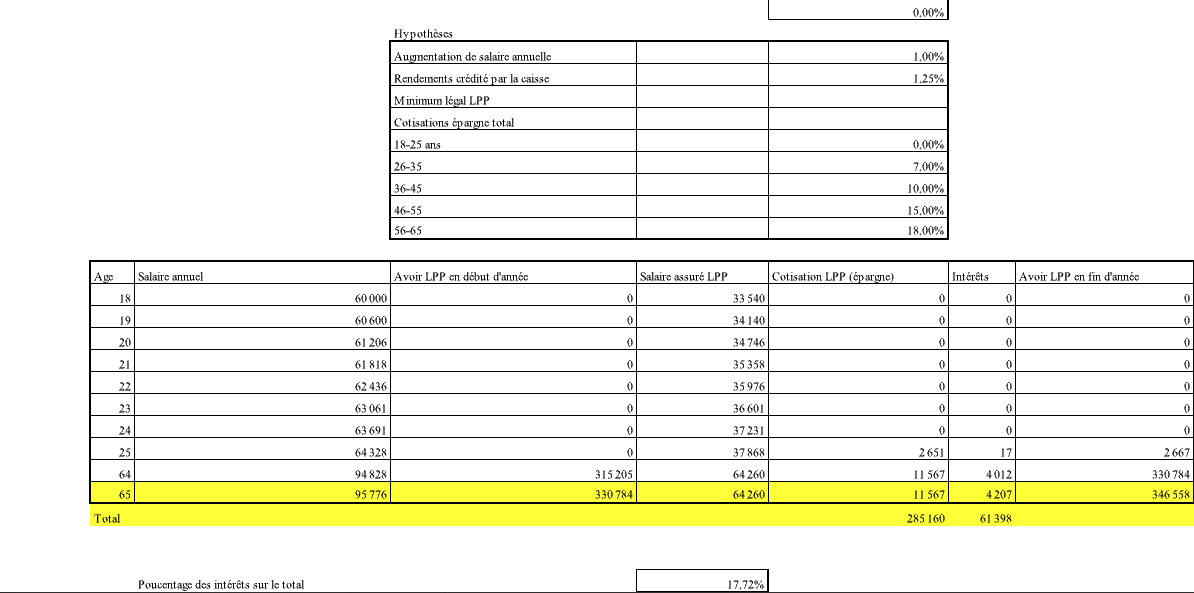
Example: An employee who works for the same company from age 18 to 65, with a salary of CHF 60,000 that increases by 1% per year, would generally end up with:
[5] Ordinance on Occupational Old-Age, Survivors’, and Disability Pension Plans (OPP 2) of April 18, 1984, RS 831.441.1
- CHF 350,000 in retirement savings (approximately) if the employee’s employer chooses a pension fund that credits the minimum statutory rate of return (1.25%, assuming a constant rate over the entire period). The portion of the accumulated retirement savings attributable to compound interest amounts to 17.72%.
- CHF 500,000 (approximately) if the employer has opted for a pension fund that credits an average annual return 2% higher than the statutory minimum return (3.25%, assuming this rate remains constant throughout the entire period). The portion of the accumulated retirement savings attributable to compound interest amounts to 41.75%, or slightly less than half of the total retirement savings accumulated over the period.
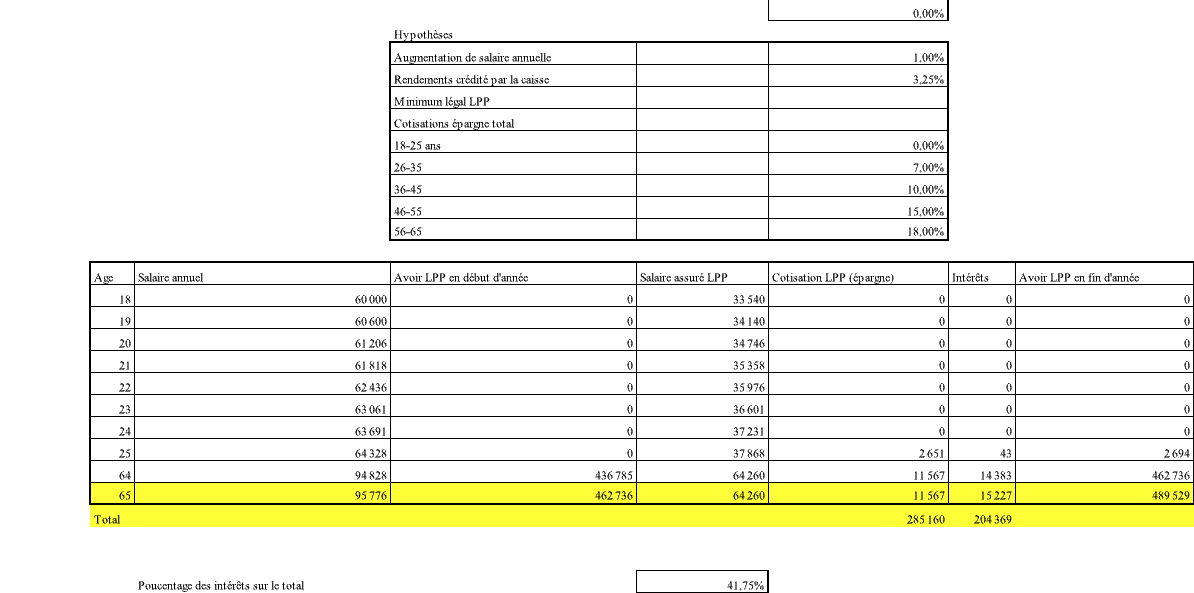
In both of the examples above, the costs to the employer remained the same. The employer simply chose a pension fund that offered better returns. With an average return of 4.49% over five years, Profond[6] took first place in 2025 among semi-autonomous joint and collective pension funds, ahead of Ascaro[7] (3.70%) and Copré[8] (3.35%)[9]. Unfortunately, in practice, employers cannot freely choose their pension fund. For example, Profond requires a minimum of 10 employees, while Ascaro requires 15. Consequently, employers who do not meet these numerical criteria cannot join these funds. They will therefore have to settle for Copré, subject to acceptance.
The main criteria to consider when comparing health insurance plans are:
[7] www.ascaro.ch
[8] www.copre.ch
[9] https://www.bilan.ch/story/caisses-de-pension-les-laureats-du-grand-classement-2025-553565156053, last accessed on June1, 2026.
- Rate of return on assets ( return credited to each insured person's retirement savings year after year)
- Technical rate: the fund's projection of its future returns. A low technical rate encourages redemptions.
- Coverage ratio: the fund’s ability to meet its obligations if all insured individuals were to retire at a given point in time. A high coverage ratio reduces the risk that insured individuals will see their retirement savings reduced during a financial restructuring or a reduction in returns intended to shore up the fund.
- Conversion rate: the conversion factor used to convert pension savings into a monthly pension payment. It is set at 6.8% for the mandatory portion; it is flexible for the voluntary portion.
- Administrative and management fees: These are the operating costs of pension funds, which are generally shared equally between employees and employers. These fees vary by fund, ranging from CHF 62 to CHF 400 per employee per year. It is advisable to compare these fees with the funds’ past returns, although past returns offer no guarantee of future returns. For example, COPRE has some of the highest fees, at CHF 396 per insured person per year, but has generated above-average returns in recent years.
The employer's share
The employer is legally required to cover at least 50% of the contributions paid to the pension fund (Art. 66, para. 1, LPP). The employer is free to increase this share up to 100%, or even beyond. An employer’s LPP contribution exceeding 50% allows, for a given gross salary, an increase in net pay without raising social security contributions (excluding LPP). For a given net salary, this reduces social security contributions (excluding LPP). This is because social security contributions are calculated based on gross salary, not net salary. In other words, increasing the employer’s LPP contribution is a tool for tax optimization in the broad sense, as it allows both the employer and the employee to reduce their social security costs.
However, tax restrictions must be taken into account when the employee is also a shareholder of the company. Tax authorities consider that as soon as employer contributions exceed 2/3 (instead of 50%), the employee-shareholder receives a significant monetary benefit, unless other employees who are not shareholders receive the same or more favorable treatment. Some advisors might instinctively—and justifiably—argue that the shareholder-employee holds an executive position and that, therefore, differentiating between them and other employees under LPP plans is both possible and defensible. This line of reasoning is generally not open to criticism, but it is typically rejected by tax authorities if the shareholder-employer is the sole participant in “his” plan, even in the presence of a virtual group. An actual group of non-shareholder third parties is essential. At a minimum, another group of employees must receive an employer contribution in the same proportions—that is, a level of employer contributions equal to or greater, in percentage terms, than that of the employee-shareholder.
Employer Contribution Reserves (Art. 331, para. 3, CO)
Any employer may establish an employer contribution reserve (“RCE”), which corresponds to an advance payment of the employer’s share of contributions to the pension fund. This reserve applies exclusively to the employer’s share of contributions, thus excluding the “employee” share. Its amount is capped at five times the annual amount of employer contributions. For example, if a limited liability company (Sàrl) employs someone with an insured salary of CHF 100,000, the savings rate is 10%, and the contribution split is 50/50, then the annual employer’s share amounts to CHF 100,000 * 10% * 50% = CHF 5,000. The maximum amount of the RCE is therefore 5 × 5,000 = CHF 25,000.
The funds contributed are permanently and irrevocably allocated to the LPP: no refunds are possible. The only authorized use of this reserve is to pay employer contributions. In other words, the employer may build up a reserve in one year (N) and, in the following year (N+1), draw from that same reserve to pay its employer’s share of contributions. As noted, this applies only to the employer’s share. Thus, the employer must in all cases transfer the portion of contributions attributable to employees (“employee’s share”) to the pension fund.
Depending on the pension fund, the RCE may be invested using the same investment strategy as the fund’s other assets and may earn the same return as the insured persons’ retirement assets (interest). This type of investment can generate substantial returns depending on the chosen investment strategy, but carries a risk of volatility when the funds are used, since some pension funds require that the assets be liquidated (sold) when the RCE is used to pay the employer’s contribution, rather than through a series of accounting entries.
From a tax perspective, contributions to the RCE are, in principle, deductible from the company’s taxable income. This is one of the few exceptions to the principle of periodicity. In fact, this approach allows the employer’s share for years N+1 through N+6 to be deducted in year N. This constitutes a deduction of a future expense, which is generally prohibited under tax law. Finally, certain cantons allow, under certain conditions, the tax deduction of payments made after the end of the fiscal year. The conditions vary by canton but can be summarized as follows: 1) payments made before the filing of the tax return for year N, 2) proof of payment must be attached to the tax return, 3) the payment must be made before the approval of the financial statements for year N. The deadline for making the payment varies by canton: up to 6 months after the financial statement closing date in Geneva, Bern, Fribourg, and Vaud, and up to 7 months in Valais.
The Value Fluctuation Reserve
The value fluctuation reserve (“VFR”) is a key risk management mechanism in pension funds. Its purpose is to absorb fluctuations in the financial markets and preserve the fund’s financial stability in the face of asset volatility. The target level of the RFV is set by the pension fund based on its investment strategy: the more risky assets are included in the strategic allocation (i.e., the higher the equity allocation), the larger the RFV must be. The RFV stems directly from the principle of capital guarantee for plan participants, a hallmark of the Swiss occupational pension system. In fact, insured persons generally leave their pension fund with their retirement savings (consisting of contributions deducted from their salaries) plus interest. This capital is paid out to them as a lump sum, as a monthly pension, or as a combination of both. Investment risks, such as stock market fluctuations, interest rate changes, or foreign exchange risks, are not borne directly by the insured, but by the pension fund itself. If the institution’s financial situation deteriorates despite this reserve, the employer may be required, on a secondary basis, to contribute to the restructuring measures provided for by applicable laws and regulations. These measures may, on an even more secondary basis, extend to the insured individuals.
The RFV is funded primarily by returns on pension assets and, where applicable, by employer contributions. In other words, as long as the RFV is not fully funded, the financial returns generated each year by the pension fund are not credited in full to the employees; a portion is allocated to the RFV. The RFV thus acts as a “safety cushion” designed to strengthen the fund’s resilience and reduce the risk of underfunding.
The employer may make voluntary contributions to the value fluctuation reserve. These contributions constitute non-refundable contributions from the employer to the pension fund. Employers therefore cannot recover these funds or use them to pay the employer’s share of contributions (unlike the employer contribution reserve). These payments are not subject to social security contributions and are deductible from income tax under certain conditions.
Depending on the pension fund’s regulations and the number of insured individuals in the plan, the RFV is partially or fully dissolved when one or more insured individuals leave the plan (e.g., retirement or a change of pension fund). By choosing a pension fund that allows them to recover “their” share of the RFV upon departure, insured individuals ultimately benefit from nearly all of the returns on their pension assets. This is a significant advantage given the amounts accumulated over an entire career.
A Powerful Tax Optimization Tool
For a self-employed individual or executive earning more than CHF 100,000 in annual income, the LPP supplementary pension plan is one of the few legal mechanisms that can significantly reduce income tax, wealth tax, and social security contributions, while deferring taxation.
It is possible to set up a dedicated pension plan for benefits beyond the mandatory minimum within a collective foundation even with just one employee, provided there are sufficient pension assets. This allows you to combine:
- A customized asset allocation ( up to 100% in stocks in certain scenarios)
- Significant LPP buybacks, deductible from income tax
- Contributions to reserve funds (RFV & RCE) are deductible from the employer’s taxable income (benefits related to social security contributions, income tax, and wealth tax)
Mandatory requirements: The structure must comply with the principles of appropriateness, collectivity, equal treatment, and certainty. These requirements are scrutinized by the cantonal tax authorities. An improperly structured arrangement may result in the denial of the deduction, potentially accompanied by a 35% withholding tax, income tax, profit tax, and late-payment interest.
Conclusion
The LPP supplementary pension plan is a legal and tax framework whose value lies in the ability to reduce social security contributions, defer taxation (on income and wealth) until funds are withdrawn from the pension fund, and potentially pay less income tax when LPP assets are withdrawn. Depending on the pension fund chosen, employees may manage their own assets within a defined framework.
When used properly, the LPP allows an entrepreneur to reduce 1) social security contributions, 2) income tax, 3) wealth tax, and 4) income tax, while still having the option to manage their LPP assets more or less actively.
The tax advantage is such that an entrepreneur may find himself with a very substantial fortune upon retirement, simply because he chose a tax-efficient structure and an investment strategy that aligns with his profile.
Since every situation is different, a personalized analysis is essential to determine the optimal plan based on the client’s profile, family situation, retirement timeline, and financial goals.
Cedric Panchaud is an attorney, holds a doctorate in law, is a licensed notary, and is a certified tax expert. He regularly speaks at continuing education seminars (ISIStax, OREF/EXPERTsuisse). This article is provided for informational purposes only and does not constitute legal or tax advice.
The mandatory LPP covers the portion of annual salary between CHF 26,640 and CHF 90,720 (2026 amounts), with contribution rates and a conversion rate (6.8%) set by law. The non-mandatory portion of the LPP covers any contributions the employer voluntarily makes above this legal minimum, with contribution rates of up to 35% of the insured salary and often a free choice of investment strategy. It is this portion that offers the greatest potential for tax optimization.
Once the insured annual salary reaches CHF 150,000, more than half of the insurable salary falls into the non-mandatory category. It is at this income level that structuring one’s occupational pension plan becomes particularly advantageous from a tax perspective.
The 1e Plan (Art. 1e OPP2) is an open-ended plan for the portion of salary exceeding approximately CHF 136,080 (2026 threshold). Employees are free to choose their investment strategy from up to 10 options offered by the pension fund and benefit fully from market performance, minus fees.
In a 1e plan, the employee no longer benefits from a capital guarantee: if the markets fall by 10%, the employee bears the full loss. In return, insurance premiums are generally lower. All 1e plans fall under the LPP’s non-mandatory portion, but the reverse is not true.
The rate of return credited by the pension fund has a direct impact on the retirement benefit, often much more so than the amount of contributions, due to compound interest over several decades.
Five main criteria: the rate of return on assets, the technical rate (projected future returns), the coverage ratio (ability to meet its obligations), the conversion rate (the monthly amount paid out based on the principal, which is freely determined within the framework of the non-mandatory portion of the LPP), and administrative fees, which range from CHF 62 to CHF 400 per insured person per year, depending on the pension fund.
The RCE (Art. 331, para. 3, CO) allows an employer to pay its employer’s share of contributions in advance, up to five times the annual amount of its employer contributions. In principle, this amount is deductible from taxable income at the time of payment, even if it is used to fund contributions for subsequent years; this is a rare exception to the principle of periodicity under Swiss tax law.
The LPP, and particularly the non-mandatory portion of the LPP, allows for reductions in income tax, wealth tax, and social security contributions while deferring taxation. This can be achieved through high savings contributions, buybacks, or contributions to reserves (RFV, RCE). However, the structure must comply with the principles of adequacy, collectivity, equal treatment, and insurance; otherwise, the tax authorities may disallow the deduction. An individualized analysis remains essential to determine the optimal structure based on the client’s profile.

September 21, 2026

September 1, 2026